
An IELTS Academic Task 1 map response needs to communicate locations and, where different dates are shown, the changes between them. “There was a car park” and “there was a garden” may both be true without explaining the main event: one feature took the place of the other.
In the illustration below, the car park and garden occupy the same plot in different years. Describing them separately could make a reader imagine two locations. First, see how LetsWords feedback identifies the missing relationship, then check the wording against the map.
LetsWords offers map tasks, practice focused on individual criteria, and feedback on complete Task 1 responses. The reference guide explains the format before you write. Feedback is tied to a specific line, such as one that reverses the old and new features.
What counts as a change on a map?
A task may show two past states, an existing site and a future proposal, or several layout options. Read the labels first: completed redevelopment and a proposed change require different wording.
The diagrams below compare two past years, 2010 and 2025.
According to the IELTS Academic Writing format, a complete Task 1 response requires at least 150 words.
Two diagrams of the same place
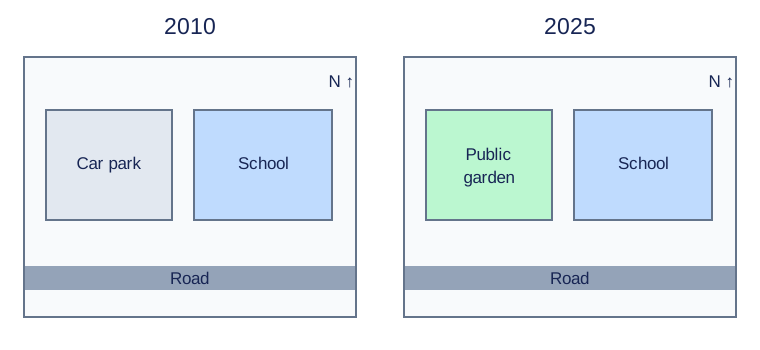
The school is on the right in both diagrams. The N arrow points up, so the left side is west. The road runs south of the school and the plot.
| Feature | 2010 | 2025 |
|---|---|---|
| Plot west of the school | Car park | Public garden |
| School | Same location | Same location |
| Road | South of the features | South of the features |
The diagrams do not tell us exactly when the work started or how long it took. They do not explain why the car park was removed either. None of that information is necessary to describe the visible change.
What happened to the car park? Feedback on two sentences
There was a car park in 2010. There was a public garden in 2025.
LetsWords feedback on Task Achievement: the objects and dates are named, but the replacement is missing. The diagrams show the garden occupying the former car park’s site west of the school; the text does not. Connect the old and new states as one change.
Adding another general sentence is less useful than expressing the transformation itself. Then the former feature, new feature, and location become one clear relationship.
After revision:
By 2025, the car park to the west of the school had been replaced by a public garden.
It is now clear that the garden took the car park’s place. To the west of the school identifies the plot. Had been replaced relates the completed change to the later date.
The sentence does not identify who performed the work. That information is unnecessary here: the important point is what happened to the feature. The passive construction keeps attention on the visible transformation.
A simpler alternative: The maps show that a public garden replaced the car park. The new garden is now the subject. Simpler grammar retains the main information: which feature took the former one’s place.
See what this feedback finds in your response.
Correct English can describe the opposite change
Incorrect: The public garden was replaced by a car park.
Correct: The car park was replaced by a public garden.
In the passive construction, the feature before was replaced is the one removed. The feature after by is its replacement. Swap the nouns and the grammar remains correct, but the description contradicts the diagrams.
Compare the active version:
A public garden replaced the car park.
Here, the new feature comes first. You cannot memorise the noun order separately from the construction. Identify the old and new states, then check which role the verb assigns to each noun.
The dates determine whether the redevelopment is complete
Wrong for these dates: The car park will be replaced by a public garden.
Correct: By 2025, the car park had been replaced by a public garden.
Future wording would describe a plan or prediction. In these diagrams, 2025 is the state after the change. Will be replaced therefore changes the time relationship.
For a different task labelled proposed plan, future or proposal wording may be appropriate. Read the labels instead of carrying the verb form over from a previous map.
Do not guess the specific year of the work. The car park was removed in 2020 cannot be established from diagrams dated 2010 and 2025. They give observation points, not the event’s exact date within that period.
Location: west of a building or inside it?
Incorrect: The garden is to the east of the school.
Correct: The garden is to the west of the school.
North is marked at the top, so west is on the left. The garden has the same position relative to the school as the former car park. Describing its location helps connect the two dates.
If directions are not marked on a map, do not automatically assume that the top is north. Use supported landmarks, such as next to the entrance, opposite a named building, or along the road shown.
Also distinguish to the west of the school from in the western part of the school. The first places the feature west of the school. The second places it within the school’s western part, which the illustration does not show.
Words that preserve the comparison
Instead of is useful here: In 2025, there was a public garden instead of a car park. It expresses replacement rather than proximity. Try a free sentence check on instead of.
If you use a comparison, name the change. Compared with 2010, the area looked different says too little. Try a more precise sentence on compared to, which also offers one free sentence check.
There is no need to list every construction verb you know. Replace precisely fits this observation. Expand, relocate, and convert describe other changes and should not be added merely for variety.
What the next attempt tests
After reading the example, it is easy to reproduce the sentence about a car park. Another map will require a different relationship: relocation, an addition, or a feature remaining unchanged. That is where you discover whether you can connect sentence structure to the picture’s content.
The line graph worked example shows the scope of a complete visual response. Describing maps, though, takes practice on map tasks themselves.
In LetsWords IELTS Writing Task 1, you receive another map and describe it independently. Choose a single criterion or a complete response. The feedback checks whether the English matches the diagram, while the reference guide and checklist help you inspect the text before submitting it.
Practise maps in LetsWords so that replace, tense, and direction work together to describe the change actually shown. Start preparing by selecting your goal and level, then try the feedback before paying.