
Put a finger on the entrance before you press play. On a map, on your left changes when you turn. On a diagram, on the left of the filter stays put. The skill they share is keeping a known reference point while the speaker describes something new.
For your first trip through the yard, keep the recording playing. Mark the junction where you lose the guide. In LetsWords you can sit a Listening test with a single play and afterwards use Listen here to hear the direction behind a missed label. If you often lose a mark on a turn you thought you understood, start your IELTS Listening preparation with LetsWords.
Follow the guide around a pottery yard
North is at the top. Each letter marks a room opening onto the path. The horizontal branches meet the same central path. Start at the south gate, facing north.
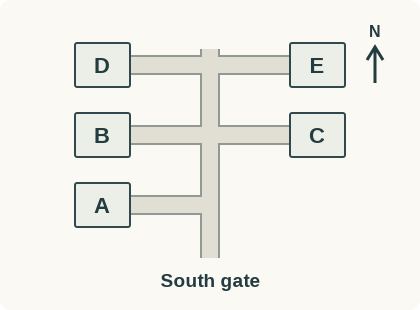
Which letter marks each location? 1. Tool store. 2. Kiln room. 3. Packing room.
Read the transcript and check your answers
Transcript
Come in through the south gate. Just inside, on your left, is the tool store. Keep walking north. You’ll see a turning on your right. That takes you to the staff room, so walk past it. At the next junction, turn right for the kiln room. Now turn round and walk back to the central path. Turn left there, towards the gate. At the first junction you reach, the packing room is on your right.
Trace the answers. The tool store is A, the first room west of the gate. The first right leads to C, which the guide identifies as the staff room. The next right reaches the kiln room at E. On the way back, the guide faces south. West is now on the right, so the packing room is B. D is west of the kiln room at the same junction. Walking south to the next junction rules it out.
Try the same skill on a machine
This time the direction of flow stays fixed. Choose a label for each numbered part from screen, leaves, valve, outlet. Two words are spare.
water inlet → [ 1. ______ ] → clear chamber → [ 2. ______ ] → outletRead the transcript and check your answers
Transcript
Water comes in from the left. First it passes through a screen that catches leaves. You can watch the water in the clear chamber. Just beyond that is a valve. Turn it to stop water leaving through the outlet.
1 screen · 2 valve. Leaves fit inside the story, but they are what the first component catches. A useful diagram label names the component itself. In both exercises, the printed gate or chamber gave you somewhere to start again if you lost your place.
Where did you lose your place?
If you put the packing room at D, return to the kiln room at E and trace just the journey back. When you reach the central path, your finger is at the D/E junction. The instruction to turn left points you south. The guide then says “at the first junction you reach”. You have to move your finger to another junction before choosing a room. D would put you on the west side but one junction too far north. C would put you at the right junction but on the east side.
Those two wrong letters call for different replays. For D, listen for the words that move you to the next junction. For C, turn your pencil to face south. In LetsWords Listening, choose map labelling and the course picks a part rich in map questions. You can test whether you can follow a new speaker through a new layout, then check the transcript at the turn you missed.
For a change of task, work through a multiple-choice recording with its transcript, or label a diagram from a Reading passage. To build the skill under exam conditions, start your IELTS preparation in LetsWords.